
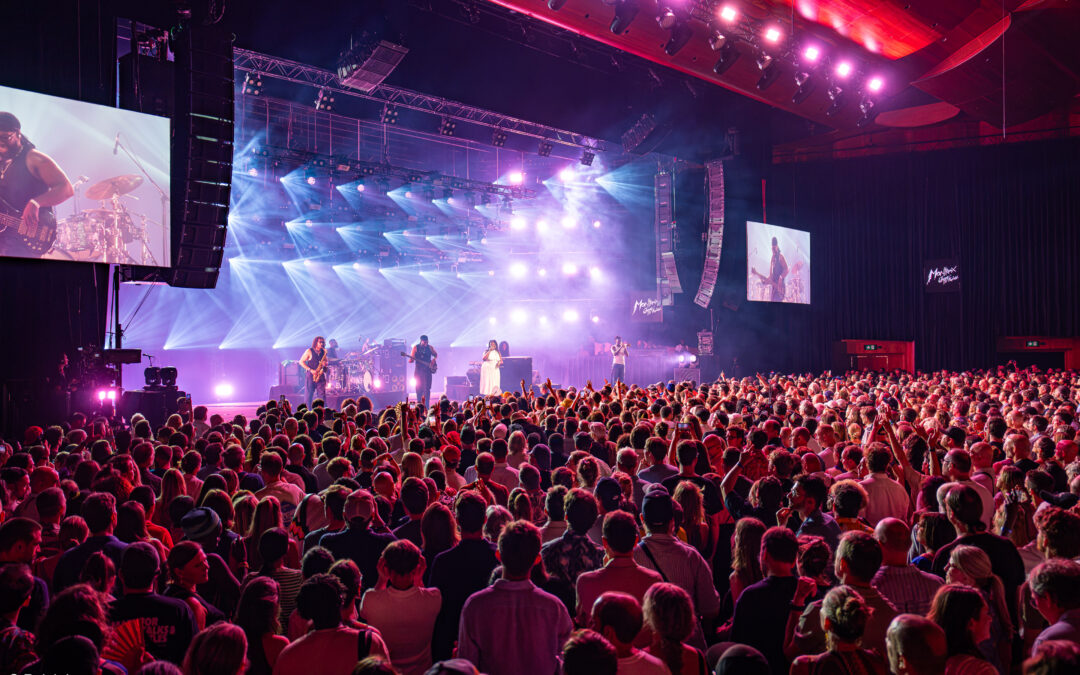
Three venues. One central view. A live production network built to keep Montreux’s music moving.
An iconic festival with a demanding production environment
The Montreux Jazz Festival (founded in 1967 by Claude Nobs) has grown into one of Europe’s most renowned music events, known for legendary performances, genre-crossing programming and a setting on the shores of Lake Geneva that has become part of the festival’s identity.
For the 2026 edition, the festival returned to its iconic venues as part of its 60th edition celebrations, bringing audiences back to the Auditorium Stravinski and Montreux Jazz Lab. Across the program, artists including Moby, Nick Cave, John Legend, Raye and special guests contributed to an environment where artistic ambition, long show days and technical precision all had to move together.
In a festival environment like Montreux, the production infrastructure must be more than powerful. It has to stay reliable through long show days, staggered build schedules, last-minute changes and the pressure of live performance. Each venue has its own setup, timeline and rhythm, but for the artists, engineers and audience, everything still needs to feel seamless.
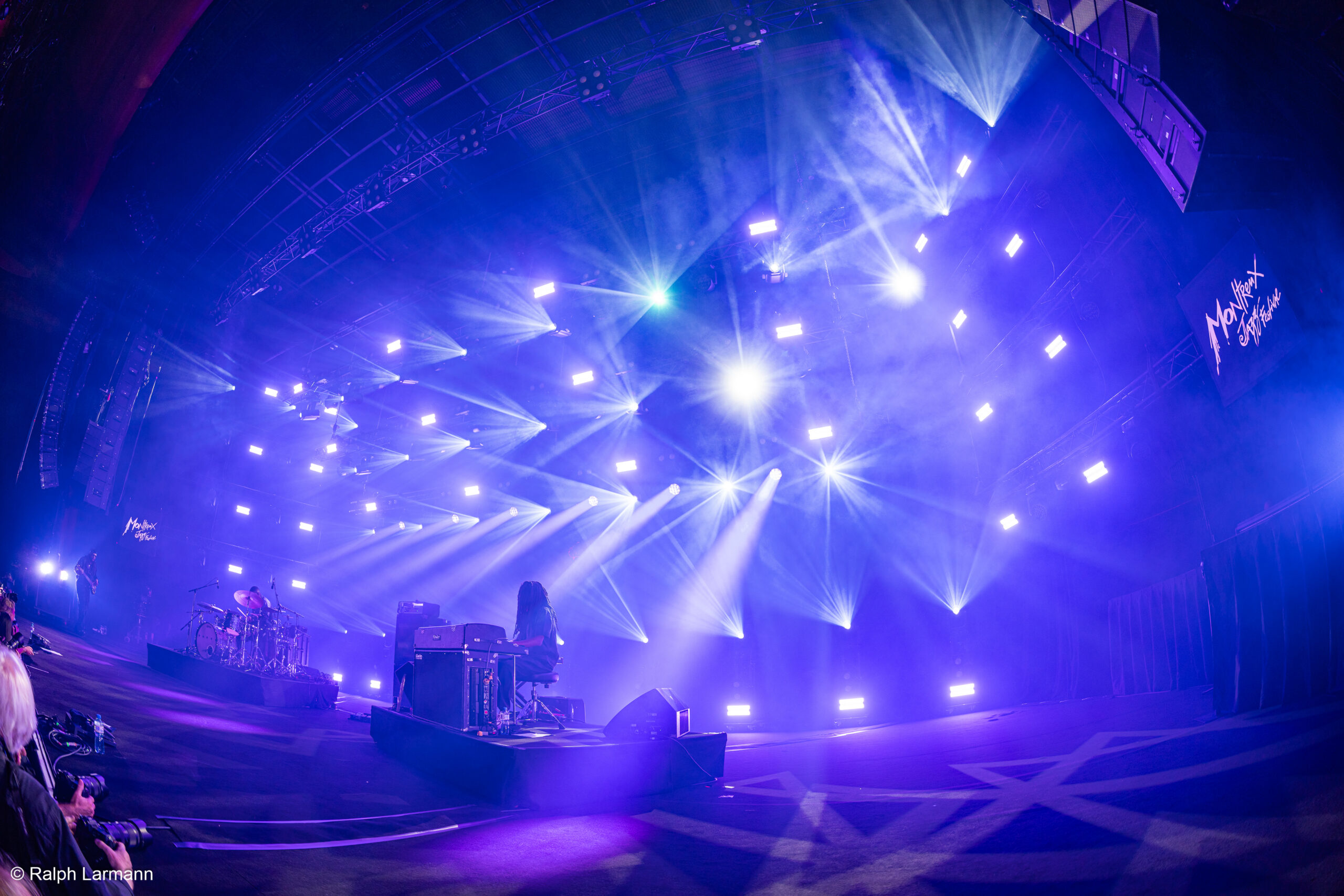
Building the backbone behind the stages
What made this deployment especially distinctive was its scale and architecture: three independent stages, each with its own Milan-AVB network, were brought into one centralized monitoring environment operated from a single control room. This is unusual because festival stages typically operate as separate technical environments; here, the teams achieved one unified operational view without compromising the isolation, timing or resilience of any individual stage network.
Delivering this integrated setup required close coordination across the festival’s technical teams, with Skynight once again playing a key role by providing and operating the lighting, audio and LED systems across the stages.
Meyer Sound supported the audio systems, with Luminex GigaCore switches forming a reliable network foundation behind the scenes. Being the Global Official Sound Partner of the Montreux Jazz Festival – Meyer Sound celebrates 40 years of partnership with the festival this year. It is within this long-standing technical partnership that the network setup for this edition took shape.
Across Auditorium Stravinski, Jazz Lab and Memphis, this infrastructure supported Meyer Sound systems, and lighting workflows in three very different production environments. LumiNode was also part of the lighting setup, helping the teams manage demanding show conditions with confidence.
For the festival, this collaboration reflects the strength of long-standing technical partnerships and their role in supporting the event’s continued evolution.
“Montreux Jazz Festival has always brought together outstanding artists, passionate audiences and trusted technical partners. Delivering a world-class experience requires expertise across every aspect of production, and we value the commitment of companies that help make this possible. Seeing our partners, Meyer Sound and Skynight, collaborate and use Luminex technology at this year’s festival demonstrates how strong industry relationships contribute to the continued evolution of the event.” – Ignacio Menendez, Partnership & Sponsoring Manager, Montreux Jazz Festival
The challenge: central monitoring without compromising network independence
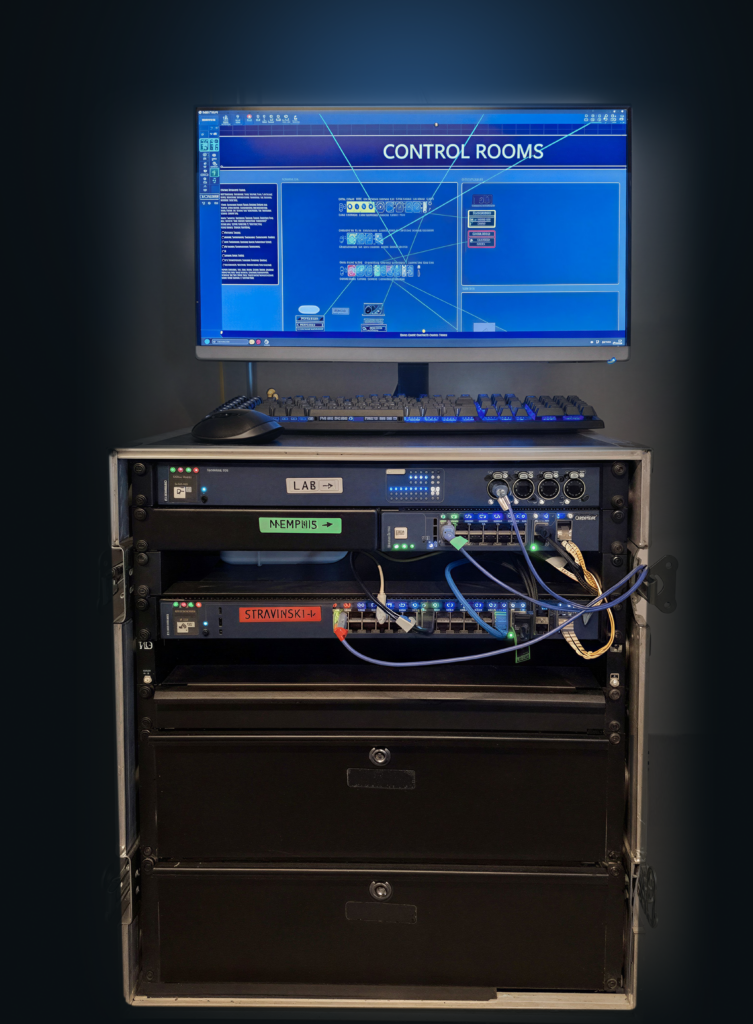 This year, the teams set out to test a new approach: connecting the three main venues to a central control room so the Meyer Sound systems on each stage could be monitored through a single Araneo interface.
While the concept of centralized monitoring offered clear operational benefits, it also introduced a significant technical challenge. Each venue operated its own Milan-AVB network, and any issue within one network (such as a power outage, device failure or disconnected cable) could not be allowed to affect the others.
Maintaining complete network isolation for time-critical Milan-AVB traffic while still providing a unified operational overview required careful network design. The solution needed to preserve local gPTP grandmaster clock at each venue while allowing engineers to monitor all three stages from a single location.
The solution: centralized visibility with isolated Milan-AVB networks
To support this workflow, Luminex GigaCore switches provided the network foundation across the three main venues, while Araneo enabled the teams to prepare, validate and monitor the entire system.
The Milan-AVB VLANs from each venue were extended to the central control room but remained fully separated. This ensured that every venue retained its own local gPTP grandmaster and that network events in one location could not impact the others. At the same time, the remaining production VLANs were interconnected, creating a shared monitoring environment across the festival.
As a result, engineers gained a centralized view of key Meyer Sound systems while preserving the resilience and independence of each individual venue. The deployment also served as a practical proof of concept for future expansion to additional stages, audio racks, lighting systems and other production networks.
“This year was an experiment; the first time we tested monitoring three stages from one central control room. Unlike many other festivals, Montreux Jazz Festival runs for 16 days, which gives us the opportunity to gradually introduce more complexity and refine the process along the way. The foundation is there, but we are continuously improving how we work. Ultimately, it is about building trust and understanding between everyone involved, allowing us to collaborate more effectively and create a better experience with the support of Araneo.” – José Gaudin, Application Architect, Meyer Sound
Prepared before arrival, deployed port by port
Festival networks are rarely built in one clean sequence. Venues come online at different moments; crews are working against tight production schedules and engineers need to start testing as soon as equipment becomes available. That makes preparation, documentation and staged deployment essential.
With Araneo, the team could prepare the network project in advance, validate the design and then deploy the system port by port on site.
“At a festival, the different venues are not built at the same time, which means not all equipment is connected simultaneously. As soon as a device is plugged in, the crew needs to be able to start working immediately. With Araneo, we can prepare the project before arriving on site and validate the network design in advance. Once the equipment is available, we can deploy the network port by port, without needing everything to be connected at once or having to check the full setup in the warehouse beforehand. Araneo is also extremely valuable for monitoring. We have a computer on site continuously logging everything that happens across the network. This allows us to go back through the logs, identify what happened, and support the sound team more efficiently during troubleshooting.”- Orson Germaud, Technical Stage Manager, Montreux Jazz Festival
Supporting Meyer Sound TIGRA, PANTHER and NADIA systems
Each venue placed different demands on the network. Auditorium Stravinski featured Meyer Sound TIGRA and PANTHER systems. Jazz Lab used a TIGRA system supported by Luminex GigaCore switches. Memphis featured a fully spatialized NADIA immersive sound system from Meyer Sound, with Araneo used to monitor the network behind it.
The modern loudspeaker systems become increasingly networked, which means that the network carries much more than audio. Control and monitoring data are part of the same operational picture, so the engineers need switches they can rely on. Configuration that does not slow them down and visibility, that helps them understand what is happening while the system is live.
“Networks are essential today, and that is especially true this year with Meyer Sound’s new TIGRA system. It is a Milan-AVB audio system where audio, control and monitoring data are carried over the network, so every loudspeaker becomes part of the networked system. For that reason, the network must be reliable, fast and easy to set up. For me, Luminex’s Araneo is one of the best solutions because it is incredibly straightforward to configure. When I arrive on site and only have two days to complete the setup, Araneo makes a real difference. Everything can be prepared and deployed very quickly, I simply plug in the loudspeakers, and the system is ready to go.” – Frank Demaret, FOH Engineer, Montreux Jazz Festival Production Team
A visual overview for lighting and audio teams
Araneo’s value was not limited to audio. With lighting and audio running on Luminex infrastructure across the venues, technicians had a visual way to follow the network during shows, detect connection issues quickly and understand device-level changes.
For lighting teams working in high-pressure live conditions, clarity matters. When the show is running, being able to see the network, understand what changed and react quickly helps reduce uncertainty and gives the crew more confidence in the system.
“I have worked with different networking solutions and gained insight into systems from various brands, but what stands out most about Araneo is how easy it is to use. It is very visual, intuitive and simple to manage. We use Araneo for monitoring all the time, because many other brands do not offer a dedicated tool like this. During a show, we can keep an eye on the entire network, immediately see if a connection is lost or if there is an issue between devices and maintain a complete overview at all times. It is a Luminex feature that my team and I truly appreciate.”- Hugo Brassy, Lighting Technician, Montreux Jazz Festival Production Team
The result: confidence, visibility and a foundation for future growth
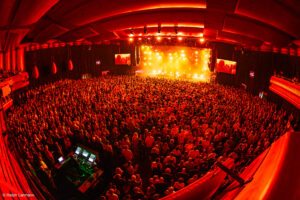 By interconnecting the three main venues and bringing the Meyer Sound systems into one monitoring environment, the production teams gained a clearer operational picture across the festival. Araneo helped them prepare before arriving on site, monitor the active network continuously and review logs when troubleshooting was needed.
For a festival that runs over multiple days and evolves continuously, this shared approach created a practical foundation for future expansion. The same concept could support additional stages, more technical disciplines or deeper integration between audio, lighting and other production systems.
Most importantly, the technology stayed in service of the experience. Every live performance depends on people, systems and expertise working together in the background. At Montreux Jazz Festival, Luminex helped provide the visibility and reliability those teams needed behind the scenes, so the focus could stay where it belonged: on the music.
Technical Network Overview
The three stages use a converged Luminex-based network infrastructure to transport, process, monitor, and distribute Milan-AVB audio alongside immersive control data (Meyer Sound NADIA), audio control data (Meyer Sound Nebra), and Shure wireless system data. The setup combines GigaCore switches, Meyer Sound Galaxy 816 processors, speaker arrays, and control-room supervision, with Stage 3 also integrating lighting network traffic (MANet3) and recording workflows.
Network Setup
In Auditorium Stravinsky and the Jazz Lab, front-of-house audio from guest and house mixing consoles is routed via AES to dedicated Meyer Sound Galaxy 816 processors. Each stage uses GigaCore 14R switches at FOH and stage positions, while GigaCore 30i switches distribute Milan-AVB audio to the loudspeaker arrays.
Stage 3 Memphis uses a GigaCore 20t at FOH for Milan-AVB audio and the lighting network, the latter, controlled from an MA3 console with two LumiNode 12 units in the dimmer city. A GigaCore 14R on stage left connects the local Galaxy 816 processors, Clear-Com FreeSpeak, and immersive loudspeaker infrastructure.
Signal Distribution
Across all stages, Milan-AVB streams are sent to local Galaxy 816 processors, where they are processed and distributed to the loudspeakers on the stage left, stage right and center positions, with speaker arrays including Meyer Sound Panther, Tigra, Ultra-X, LINA, and 2100-LFC units. Stage 3 additionally supports spatial audio and multitrack recording.
Control Room
From the control room, the network infrastructure of all three stages can be accessed, monitored and supervised independently through the Luminex ecosystem. The various parts of the control room were operating through a GigaCore 30i, a GigaCore 16i and a GigaCore 18t. Operators can monitor switch status, port activity, bandwidth, VLAN distribution, end-device connectivity, PoE status, Milan-AVB clock stability, stream reservation, stream status, and listener/talker relationships using Araneo.
Summary
For this network across three stages and a control room, a total of 21 GigaCore switches were used; 11x GigaCore 14R, 7x GigaCore 30i, 1xGigaCore 20t, 1x GigaCore 16i and 1x GigaCore 18t next to 2 x LumiNodes and no less than 125 end devices all monitored by several instances of Araneo.
This non-intrusive monitoring approach allows each stage to be supervised separately without affecting the others. If a fault occurs on one stage, it remains isolated and does not influence the operation of the other stages. This independent, stage-by-stage supervision is a distinctive advantage of the Luminex setup and expertise, providing fast fault detection, stable Milan-AVB operation and a scalable foundation for future multi-stage network designs.
Products used
Araneo network management software
Contact us
Would you like to learn more about how Luminex solutions support large-scale live events such as the Montreux Jazz Festival, or do you have specific questions about this use case? Feel free to contact our team via info@luminex.be for more information.